
A Green Year in Chakwal District
An honest monsoon, roads that turn into green tunnels, and a driver's-eye look at the invasive and native plants remaking a semi-arid landscape.

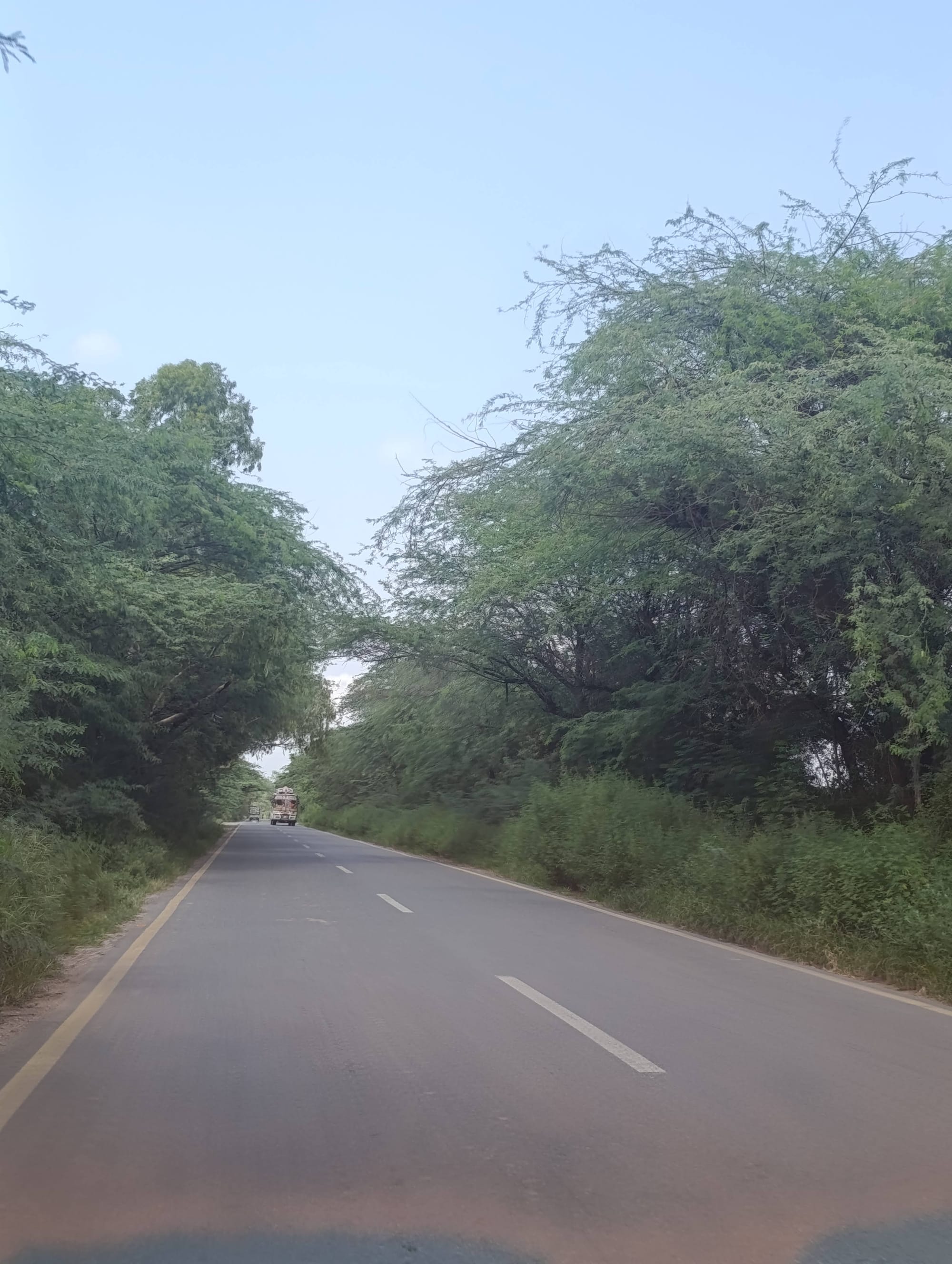
A note from the roadside, high summer 2026.

Something has happened to this corner of the Chakwal district, and it has happened in green. We are used to a semi-arid palette out here — dust, straw, the grey-green of thorn scrub — but this year the pre-monsoon westerlies rolled in with a run of proper local thunderstorms, the monsoon that followed has been an honest, average one, and the whole landscape has simply switched on. The hills are green to their tops. The seasonal streams are running. Field edges that are normally cracked earth are furred with grass.
I will be honest before I go any further: I am neither a botanist nor a meteorologist. What follows is a driver's-eye travelogue, not a field guide. If I mis-name a plant or mangle the weather, treat it as enthusiasm rather than expertise, and do write in to correct me.
Not quite Wales — but you would be forgiven

Driving these roads at the moment, I keep getting little jolts of somewhere else. Round a bend under a dripping canopy and for a second it could be a lane in Wales; a long green cutting and it is the Lake District; a poplar-lined straight and my mind jumps to rural France. It never lasts — a Bedford truck or a buffalo puts me firmly back in Pothohar — but the fact that a semi-arid district can, for a few monsoon weeks, throw up that kind of greenery still amazes me.
Some of the credit is human. The Punjab government's cleanliness drive has kept pace with the season, and roadside upkeep has genuinely helped: verges cut back, litter cleared, drains running. A tidy road with green walls on both sides is a very easy thing to enjoy.
The mesquite that builds cathedrals
Now to the plant doing most of the theatrical work: Neltuma juliflora — the mesquite locals call keekri, and which people often, and wrongly, file away as a wild kind of acacia. It is not really our friend. It is an aggressive invasive, greedy with groundwater, thorny, and forever colonising ground the natives would rather keep.
And yet. Left alone along the roads, these six-metre trees lean in from both shoulders until they meet overhead, and you get these accidental green arches — whole tunnels of shade thrown clean across the carriageway. The forestry department comes along, marks the trunks, and (I suspect) quietly enjoys the fact that the roads have ended up handsomely tree-lined at exactly zero cost and zero effort on their part. The love/hate relationship with juliflora continues, and this year the "love" column got a few extra entries.
Lantana: the pretty coloniser


The other great opportunist is Lantana camara, and it is having a wonderful year. There is a lovely irony here: down in Lahore, a couple of hundred kilometres south, this exact plant is sold in nurseries as a cheerful ornamental. Up here it needs no selling — it has taken the job on itself.
Lantana likes an edge and hates shade, so it does something very useful to look at: it lines itself up along the sunlit margins of roads, paths and channels and packs into a solid, flower-studded hedge, orange and yellow and pink all at once. Where the mesquite arches overhead, the lantana walls you in at eye level. Together they turn an ordinary farm track into something you slow down for.


These are the fence-and-hedge country roads I have come to love this year. In the rain they are frankly a mess — the surface turns to soft mud and clay and you pick your way through — but hemmed in by green on both sides, windows down, they are about as soothing a drive as this district offers.
The locals, holding their ground
It would be easy to let the invaders have all the attention, so a word for the home team — the indigenous species that built this landscape long before the mesquite and the lantana turned up. They get squeezed, but they are far from beaten, and I lend them a hand where I can — clearing a smothering tangle, leaving a seedling room to breathe.


Beri (Ziziphus mauritiana, the jujube) is a shape-shifter. Left as a thorny bush it holds a field corner nothing else will touch; given room and years it grows into a mighty tree whose hard, close-grained wood is prized for furniture; and it takes happily to a blade, so it can just as well be trimmed and laid as a hedge. Bush, tree or hedge, it is one of the toughest and most useful natives we have — and always generous with its little apple-tasting fruit.

Phulai (Senegalia modesta, long known as Acacia modesta) and keekar (Vachellia nilotica) are our real acacias — the genuine article that keekri only pretends to be. Phulai is a proper Salt-Range tree, good for gum and hard wood, but you rarely see it reach full height around here: relentless overgrazing keeps it nibbled down to a low, stunted scrub, as on the stony hillside above. Give it a few years' respite from the goats and it would stand tall again.

And kahu (Olea europaea subsp. cuspidata, the wild olive — you may also see it as Olea ferruginea) is the aristocrat of the group: slow, hard-wooded and aromatic, usually found keeping company with phulai on the lower slopes. Where these natives are hanging on, the land still remembers what it is supposed to look like.
Next stop: the hills and the streams

All this roadside green is really just the overture. What the rains have really done is up in the folds of the country — the hills gone properly green, the valleys filling out, and the valley-bottom seasonal streams running clear again. That is where I am headed next, and where the real Wales-and-Lake-District moments live.
So consider this Part One. In the next post I will leave the tarmac, follow the water downhill, and see just how far this green year really goes.
Words © Akber Choudhry / bhaun.pk. Roadside photographs © Sameera Batool. Plant reference photographs via Wikimedia Commons / their photographers. Species notes are a keen amateur's best guess, offered in good faith — corrections welcome.